Wednesday, March 31, 2010
Sunday, March 21, 2010
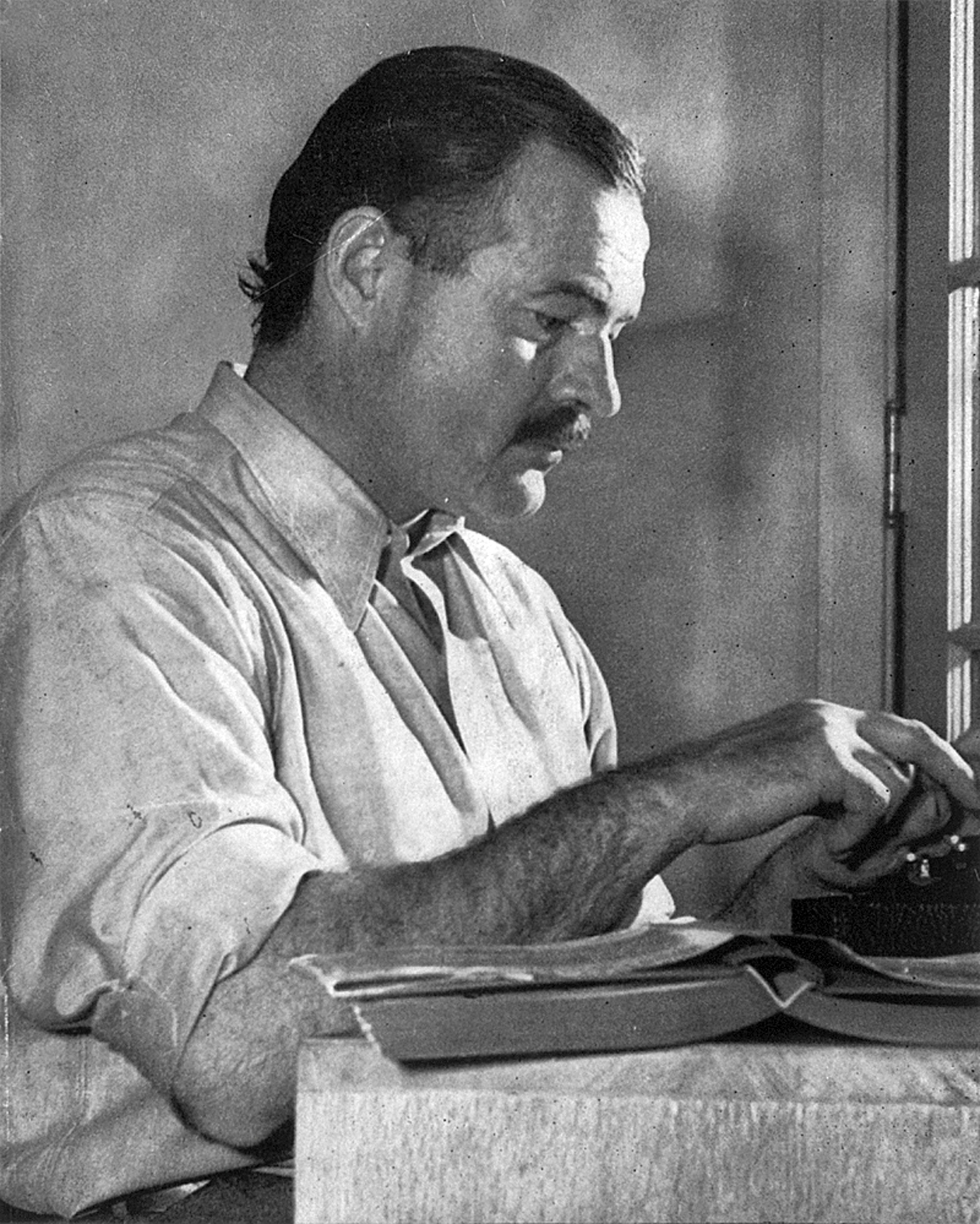
An E! True Hollywood Exclusive: Ernest Hemingway
Ernest Hemingway was born in 1899 in
Hemingway worked as an ambulance driver for the Red Cross on the Italian Front during World War I. Supposedly he was the first American to be wounded during World War I when he was hurt by mortar fire. He and the nurse who took care of him when he was injured during the war fell in love, but she left him for an officer. This was his first serious relationship and probably influenced his writing of A Farewell to Arms, in which a soldier, injured in World War I, and the nurse who takes care of fall in love.
When the war was over, Hemingway married Hadley Richardson and moved to
After writing many stories about
Hemingway married Mary Welsh, his third wife, in 1946. He had covered World War II and many of his friends were dying, including Fitzgerald and Stein, and he had many health problems, which caused him to be depressed. He didn’t write very much, and his last work, The Old Man and the Sea, for which he won the Pulitzer Prize, was published in 1952. He committed suicide in 1961 in
Sunday, March 14, 2010
The Old Man and the Blog Post
Many themes and qualities of Ernest Hemingway’s novella The Old Man and the Sea, the story of an old fisherman,
The old man was thin and haunt with deep wrinkles in the back of his neck. The brown blotches of the benevolent skin cancer the sun brings from its reflection of the tropic sea were on his cheeks. The blotches ran well down the sides of his face and his hands had the deep-creased scars from handling heavy fish on the cords. But none of these scars were fresh. They were as old as erosions in a fishless desert.
Everything about him was old except his eyes and they were the same colour as the sea and were cheerful and undefeated. (3-4)
Indeed, Hemingway writes
One aspect of Hemingway’s social beliefs that manifests itself in much of his writing is his intense misogyny. It is readily apparent in “Indian Camp,” where Nick’s father helps a American Indian woman through childbirth when all the old women of the village could not, showing that Hemingway believes men can do what women cannot and are superior in their scope of what they can accomplish. It also is demonstrated in “Hills Like White Elephants,” where the main characters, a couple, are known as “man” and the diminutive “girl.” And, it can also be seen in The Old Man and the Sea, even though no female character is ever actually present. When
…the old man always thought of her as feminine and as something that gave or withheld great favours, and if she did wild or wicked things it was because she could not help them. The moon affects her as it does a woman, he thought. (20)
When
Not only can demonstrations of Hemingway’s beliefs be found in The Old Man and the Sea, but one can also find examples of his distinct writing style that is consistent through many of his works. In many of his short stories, including “The Killers,” “Hills Like White Elephants,” “Indian Camp,” and “A Clean, Well-Lighted Place,” dialogue is a major component, often consisting of small-talk and during meal times. An excellent example is “The Killers,” in which much of the story is talk over lunch between men ordering food at Henry’s lunch-room. While The Old Man and the Sea may contain little dialogue because throughout most of the book only one character is present, when there are two characters present, the fisherman, Santiago, and his more-or-less disciple, Manolin, the dialogue is abundant, free-flowing, and decidedly Hemingway.
‘Your stew is excellent,’ the old man said.
‘Tell me about the baseball,’ the boy asked him.
‘In the American League it is the Yankees as I said,’ the old man said happily.
‘They lost today,’ the boy told him.
‘That means nothing. The great DiMaggio is himself again.’
‘They have other men on the team.’
‘Naturally. But he makes the difference. In the other league, between
‘There was nothing ever like them. He hits the longest ball I have ever seen.’ (13)
The casual banter between
Sunday, March 7, 2010
Some Analysis of Hemingway
In “The Killers,” by Ernest Hemingway, Nick informs Ole Andreson that some men were planning on killing him. Instead of reacting like Nick thought he would, Ole only remarks, “there isn’t anything I can do about it” (287). When Nick says, “Maybe it was just a bluff,” Ole tells him “No. It ain’t just a bluff.” Obviously Ole and Nick have very different points of view. While Nick is an example of someone who lives in fear of death, Hemingway has created Ole to be a person who knows that death is a reality but will not resign himself to being controlled by his fear of death. If Ole reacted strongly to Nick’s warning and immediately made plans to run away, he would be giving in to his fear of death and letting it stop him from living his life normally and peacefully. Instead of letting this happen, Ole acts as if nothing is different, allowing him to be unchanged by his fear. This, Hemingway believes, is a strong quality to have. By fearing death, Nick would be considered by Hemingway to be flawed.
“Indian Camp,” another short story by Hemingway, also shows Nick’s view and fear of death. After seeing an American Indian commit suicide, Nick asks his father about death.
“Is dying hard, Daddy?”
“No, I think it’s pretty easy, Nick. It all depends.”
They were seated in the boat, Nick in the stern, his father rowing. The sun was coming up over the hills. A bass jumped, making a circle in the water. Nick trailed his hand in the water. It felt warm in the sharp chill of the morning.
In the early morning on the lake sitting in the stern of the boat with his father rowing, he felt quite sure that he would never die. (21)
At the end of this story, Nick has experienced death, and he certainly must know that everyone must die. However, he feels that somehow he will not die. This can be explained by the fact that Nick greatly fears death—the antithesis of what Hemingway believes to be correct and honorable behavior—because Nick must fear death so greatly that he pushes all thoughts of it from his head and acts like it doesn’t exist for him. His fear of death is also apparent from how he asks his father “Is dying hard, Daddy?” That he would ask is dying is hard shows that he anticipates death to be a terrible and difficult thing, and he asks his father, whom he trusts and loves, for comfort from the alien idea of death.
“Indian Camp,” in addition, demonstrates another aspect of Hemingway’s writing: the subordination of women. Most of the story centers on Nick’s father helping an American Indian woman birth a baby, performing a caesarian section. Nick’s father turns childbirth, a job that is identified with women, into an operation which women depend on men for help with. When Nick, his father, and his uncle George arrive, Hemingway writes that “Inside on a wooden bunk lay a young Indian woman. She had been trying to have her baby for two days. All the old women in the camp had been helping her” (17). A job that could not be done by “all the old women in the camp” is achieved by a single man, Nick’s father, clearly showing that Hemingway believes women to not be as useful or capable as men. During the actual operation, the woman is restrained and treated as if operating on her is the same as operating on any farm animal.
Later when he started to operate Uncle George and three Indian men held the woman still. She bit Uncle George on the arm and Uncle George said, “Damn squaw bitch!” and the young Indian who had rowed Uncle George over laughed at him. (18)
In both Uncle George’s and Hemingway’s minds, the woman is just a “damn squaw bitch,” who is treated as more of a troublesome problem who is making it harder to perform the operation on her than as a person who is in severe mental and physical stress. During the entire trip, Nick’s dad treats his work as simply a job that needs to be done, and not a kind deed of assisting people who need their help. This is shown in the way he describes the list of steps and preparations he must make to Nick very methodically, like telling someone a recipe. He hardly mentions to Nick what stress the woman was under, simply calling the childbirth “exceptional.”
In “Hills Like White Elephants” one too sees women portrayed as subordinate to men. The general premise of the story is that a man is trying to convince a woman to have an abortion. Throughout the story, Hemingway refers to the male character as “the man,” and the female character as “the girl.” Giving the female character a more diminutive name is one manifestation of Hemingway’s belief that females are inferior.
“It’s really an awfully simple operation, Jig,” the man said. “It’s not really an operation at all.”
The girl looked at the ground the table legs rested on.
“I know you wouldn’t mind it, Jig. It’s really not anything. It’s just to let the air in.”
The girl did not say anything. (3)
Here the man is trying to convince the girl to have an abortion. The girl isn’t saying anything, intimidated by the emotional pressure he is placing on her. (“If I do it you won’t every worry?” “I won’t worry about that because it’s perfectly simple.”) Instead of having the girl voice her opinion like the man, Hemingway writes for her to keep silent, like he believes women should be.
While “Hills Like White Elephants” makes use of dialogue for almost the entire story, the first chapter of A Farewell to Arms is completely devoid of dialogue. In it, Hemingway once again writes about death, but he gives it only a mention in the last sentence, the rest of the chapter is about the scenery in which the story takes place. “At the start of the winter came the permanent rain and with the rain came the cholera. But it was checked and in the end only seven thousand died of it in the army.” Hemingway doesn’t write very long about the death due to cholera because he feels that one should not focus on one’s fear of death and worsen one’s life because of it. This is expressed in the passage by the brevity with which the narrator mentions death. Seven thousand deaths is a lot, but the narrator still holds himself about an irrational fear of it.
Sunday, February 28, 2010
Some Theme and Structure in Hemingway
There are a number of themes that find themselves in multiple short stories by Ernest Hemingway. One is the idea of men being stoic and, in the face of death, not allowing themselves to be affected with the knowledge of an unstoppable fate. In the story “Fathers and Sons,” about Nick Adams reflecting on his life as a teenager and his father, Nick’s son asks him, “Why do we never go to pray at the tomb of my grandfather?” (498). Nick’s reply is that his father’s tomb is too far away to visit; this seems more like an excuse for Nick to not have to remind himself that, like his father before him, he will die. This theme is also seen in the first chapter of A Farewell to Arms, in which Hemingway writes four paragraphs describing the scenery at the Italian front of World War I and only briefly mentions seven thousand deaths due to cholera in the last two sentences. In this chapter, Hemingway spends as little time as possible writing about death as he can, and in this way even his narrative contemplates death for as short a time as possible, forcing it out of mind.
Besides the theme of death, the structure of Hemingway’s short stories also repeats itself, and not be coincidence. In “Hills Like White Elephants,” almost the entire story is dialogue. It is all about interactions between two people, a couple, and how they feel about getting an abortion. Another story, “A Clean, Well-Lighted Place,” is also almost completely dialogue. This story is about how two waiters have differing opinions and discuss how they disagree. A third story, “The Killers,” is similarly rife with conversing between various characters: Nick Adams, employees at a lunch-counter, cold-hearted criminals, and their intended victim, Ole Andreson. In all three of these stories, human communication plays a large part in the pacing and tone of the piece. So does the diction of the characters. For the most part, communication in short stories by Hemingway does not consist of emotional realizations between characters or deep understandings of each other’s emotions. Communication is casual and largely made up of small talk. In “Hills Like White Elephants,” the couple first talks about what drinks they are going to order, and then attempt to discuss whether or not to get an abortion. However, they do not manage to see eye-to-eye and at the end still both feel uncomfortable about the subject. This lack of mutual understanding is also seen in “A Clean, Well-Lighted Place”: while the older waiter does not mind staying up late to keep his café open, the younger waiter wants to get home to his wife. Even though the older waiter tries to explain to his younger counterpart, the younger waiter is not convinced and goes home before closing time. Simple diction or small talk between characters is illustrated in “The Killers,” where most of the dialogue is about ordering and eating and food, and casually discussing the plan to kill Ole Andreson.
Sunday, January 31, 2010
Literature Lightly Examined: "Surely you're joking, Mr. Feynman!"
Richard Feynman, PhD., is full of wit in this collection of taped and transcribed conversations between him and his friend Ralph Leighton. Each enthralling anecdote will make you want to read the next, and then the next, and before finishing the book, you will regard Feynman as truly a curious character. Although Surely you're joking is written from the point of view of a theoretical physicist, Feynman is essentially a human before all else, and his frank testimony produces an extremely unbiased analysis of the human condition. "Surely you're joking, Mr. Feynman!" is an essential read for anyone, science enthusiast or not. The only grief you will feel while reading it is the realization that you have finished it.
Wednesday, January 20, 2010
Los Alamos From Below

New, from Universal Pictures:
What happens when a man who was judged “deficient” in a psychiatric evaluation has access to all the plans for the atomic bomb? What if he helped make that bomb?
What if he can open any lock and crack and safe? What if locks only encourage him?
Would it surprise you that this man was the only person to have both thwarted a German espionage agent and to have had a PhD and a Nobel Prize for his work in theoretical physics? That he was the only man to see the first atomic bomb test with his own eyes?
This summer, come to your neighborhood theater and experience the spectacle that is Micheal Cera as Dr. Richard Feynman in Los Alamos From Below: Adventures of a Curious Character. Learn more about this beloved, yet mysterious, American hero, including about his fraternity days at MIT, his drug use, and his romance with
Opening
Thursday, December 17, 2009
"Surely You're Joking, Mr. Feynman!"
I chose to read the book "Surely You're Joking, Mr. Feynman!" by Richard P. Feynman, Nobel prize winning theoretical physicist. I chose to read this book because I saw a very positive review of it by youtube.com user ockteby. Mr. Feynman's life sounds very interesting, much more so than you might imagine for a theoretical physicist. He has many eccentricities and interesting traits that I want to read about. I also am interested in how a Nobel prize winner sees the world differently from others. Finally, I want to read about Feynman's work on the Manhattan Project, and his opinions of it.
Wednesday, November 11, 2009
Seeing Voice
Thursday, October 29, 2009
Listening for Bradbury's Voice

“‘[…] Please!’ [Colonel Freeleigh] pleaded. ‘One last time, listen to me. They’re taking the phone out tomorrow. I can never call you again.’
Jorge said nothing.
The old man went on. ‘For the love of God, Jorge! For friendship, then, for the old days! You don’t know what it means. You’re my age but you can move! I haven’t moved anywhere in ten years.’
He dropped the phone and had trouble picking it up, his chest was so thick with paid. ‘Jorge! You are still there, aren’t you?’
‘This will be the last time?’ said Jorge.
‘I promise!’
` The phone was laid on a deck thousands of miles away. Once more, with that clear familiarity, the footsteps, the pause, and, at last, the raising of the window.
‘Listen,’ whispered the old man to himself.
And he heard a thousand people in another sunlight, and the faint, tinkling music of an organ grinder playing “La Marimba”—oh, a lovely, dancing tune.
With eyes tight, the old man put up his hand as if to click pictures of an old cathedral, and his body was heavier with flesh, younger, and he felt the hot pavement underfoot.
He wanted to say, ‘You’re still there, aren’t you? All of you people in that city in the time of the early siesta, the shops closing, the little boys crying loteria nacional para hoy! to sell lottery tickets. You are all there, the people in the city. I can’t believe I was ever among you. When you are away from a city it becomes a fantasy. Any town,
The door to the bedroom moved wide. The three boys stood looking in at the old man seated there on the floor. […]
There was something in his silence that made them all shut their mouths. […]
Douglass, bent down, disengaged the phone from the old man’s now quite cold fingers.
Two thousand miles away, the closing of a window.” (133-5)
This scene from Dandelion Wine, a Ray Bradbury novel made up of a series of vignettes from the summer of 1928 in
Further analyzing the events that occur in this passage, one could theorize that Bradbury believes that children understand death in a way that no middle-aged adult does, due to how Doug and the other boys are not fazed at all with the discovery of dead Colonel Freeleigh, a respected elder. That they would so casually approach his body and pick up the phone clasped in his hands shows that Bradbury believes children understand Freeleigh’s joy in the face of death. This relates to the theme of nostalgia because throughout this novel Bradbury yearns to once again view the world from the eyes of a child, like he did in the summer of 1928 in the small town he grew up in. Bradbury, at the time of writing, is now middle-aged and in between being a child and an elderly person and, due to his age, has a fear of death and wishes that he could be able to view death in the way he used to as a child, but not is unable to do so. This vignette is an expression of that desire of Bradbury.
Thursday, October 15, 2009
Oprah Interviews Bradbury
Recently on the Oprah Winfrey show the host, Oprah Winfrey, interviewed Ray Bradbury, author of the Oprah’s Bookclub Book of the Month, Dandelion Wine, a story about a young boy’s adventures in the summer of 1928 in a small Midwestern town. Here’s an excerpt from the interview:
Winfrey: So I understand that you grew up in a small town? And you would have been about
Bradbury: Yes, I was born in
Winfrey: We’re here talking to Ray Bradbury, author of Dandelion Wine, my pick for Oprah’s Bookclub Book of the Month. Now Ray, I can call you that right?, now Ray, is this a book for children? Because in it there are some very scary things, such as fear of the ravine, there is some death in it. Is this a children’s book?
Bradbury: This is a question that I get asked a lot by many people such as teachers, parents, other writers, even children themselves. There are two arguments that can be made about the matter. One is that in Dandelion Wine I idolize those summers you spend as a child while you are still very innocent and eager to explore the world. I think that many adults feel that you have to be older to understand this book because then you can feel nostalgia that is directed to those wonderful summer days where you romp around and just feel right. But what those adults don’t realize is that children are living those days. Just because the world isn’t like a small pre-depression Midwestern town doesn’t mean the summers of childhood are any less meaningful or magical. And this is the second argument: children can enjoy this book. Of course there are some characters, such as Mrs. Bentley—
Winfrey: And she is the character who is near the end of her life, and the small children don’t believe that she was ever young? And they steal the things she tries to prove to them that she once was young with?
Bradbury: —correct. Mrs. Bentley can only really be understood at the surface level by adults who have grown up, and know what it is like to look back and realize how much you have changed, and how you never will be the person you were fifty years ago. But even children can read about Mrs. Bentley and understand the loneliness she has. Even children can understand the profoundness of her existence.
Winfrey: We’ll be back right away with more from Ray Bradbury, so stay tuned.
(The audience cheers.)
Winfrey: And now we’re back. Today I invited Ray Bradbury here, to talk with me about his book Dandelion Wine. If you haven’t read it yet, pick it up at your local bookstore; just ask for Oprah’s Bookclub Book of the Month. OK Ray during the commercial break I found a quote from Dandelion Wine that I want to talk to you about. It’s on page thirteen. Here it is: “Dandelion wine. The words were summer on the tongue. The wine was summer caught and stoppered.” What exactly is dandelion wine and what does it mean to you?
Bradbury: Dandelion wine is the essence of summer. When I think back to those halcyon days of summer as a young child before the Great Depression, I think back to being a carefree young boy, brimming with excitement for the freedom to do anything and go anywhere. Dandelion wine, to me, represents all of these things to me. Dandelions, of course, are considered weeds to most adults, but to a child a field of dandelions is a magical yellow blanket of nature, which is pure, and therefore not considered an eyesore by children, not by a long shot.
Winfrey: So what I understand is that dandelion wine doesn’t actually exist? It just exists as a metaphor for the type of summer that might inspire its production?
Bradbury: That’s incorrect; dandelion wine is drunken by some, not very many people anymore. However you are correct when you say that in this book it is more of a metaphor, and in my mind it’s a metaphor for the way a child would think about their summers and a child’s point of view.
Winfrey: It was a pleasure having you on, but I’m afraid we are out of time. Ray Bradbury everybody, and his classic Dandelion Wine. Thank you!
Bradbury: I had a wonderful time coming on your show Oprah.
Winfrey: And if everyone looks underneath their seat they will see a special Oprah’s Bookclub Book of the Month edition of Dandelion Wine.
(The audience begins shrieking.)
Woman: (climbing onstage) Oh my God, I love you Oprah! I love you! Thank you, thank you, and thank you!
Oprah: Security! (woman is escorted out of the room)
Thursday, September 17, 2009
Should Steinbeck be Studied?
John Steinbeck, the author of such American classics as The Grapes of Wrath and Of Mice and Men, is no doubt an icon in American literature, and most people are in agreement that to teach an American literature course and pass over Steinbeck is quite a blunder. However, when deciding exactly which of his novels to include in a class's curriculum, there certainly are multiple viewpoints. I will herein consider Steinbeck's classic novel Cannery Row and his work of nonfiction Log from the Sea of Cortez.
Cannery Row is a novel set in an early 20th century Monterey, California, that details the lives of those who live on its namesake street, Cannery Row, at the heart of the canning district. It takes us through the ins and outs of living among the impoverished yet rambunctious populace, chronicling the friendliness with which a young marine biologist is received by the vastly different natives. In it, Steinbeck uses multiple literary devices including a vivid setting, very real and vibrant characters, and multiple symbols, such as a gopher representing the Doc, to express his message of hopefulness, making the best of one’s situation, and being understanding and forgiving towards those in different circumstances than one’s own. Because of this, Cannery Row is a perfect novel to use to teach about the many facets of American literature, and would fit very well in any class’s curriculum.
Log from the Sea of Cortez is an autobiographical account of Steinbeck’s own journey to the